Most small teams treat SEO as a publishing problem.
They ask, "How many posts should we ship this month?" before asking whether their product pages, internal links, technical foundation, and existing content are strong enough to make those posts useful.
That order creates a familiar mess: a growing blog, a few isolated rankings, old pages no one revisits, and a product website that still does not explain itself clearly to search engines or buyers.
The healthier approach is quieter. Build a search visibility system before building a content machine.
Start with the pages that already carry intent
Before writing another article, list the pages most likely to influence revenue:
- the homepage
- product and feature pages
- pricing
- use case pages
- comparison pages
- customer proof
- integration or workflow pages
These pages should make the business easy to understand. A visitor should know who the product is for, what pain it solves, what makes it different, and what to do next.
Search engines need the same clarity. Google’s own guidance on creating helpful, reliable, people-first content is a useful reminder that quality is not just word count. A page has to satisfy a real need.
Look for missing answers, not just missing keywords
Keyword research is useful, but it can mislead small teams when it becomes a spreadsheet exercise.
Instead of asking only, "Which keyword has volume?", ask:
- What would someone need to believe before trying this product?
- What comparison would they make?
- What risk would they want reduced?
- What job are they trying to complete?
- What language do they already use for this problem?
Some answers belong in blog posts. Others belong directly on commercial pages. A founder-friendly SEO workflow is partly about knowing where the answer should live.
Treat technical SEO as a prioritization exercise
Technical audits can produce hundreds of warnings. Most are not equally important.
Start with issues that affect important pages:
- pages blocked from indexing
- confusing canonical tags
- broken internal links
- slow mobile performance
- missing or duplicated titles
- weak heading structure
- thin pages competing with each other
For implementation details, Google’s documentation on how Search works and Search Console are good reference points. The goal is not to become a full-time SEO specialist. The goal is to remove the friction that prevents your best pages from being discovered and understood.
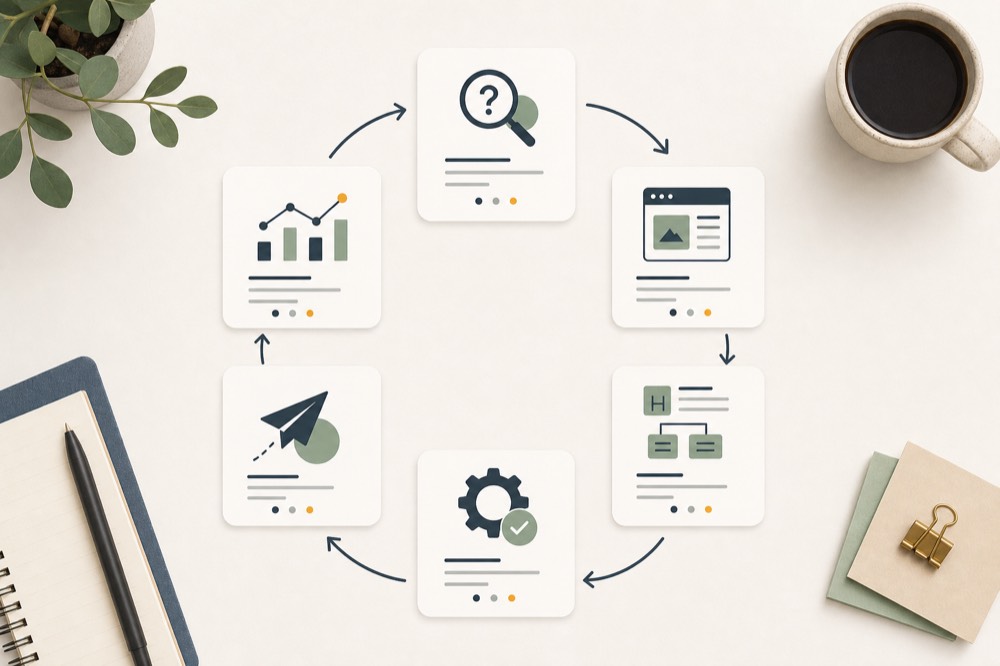
Build a weekly search loop
A simple weekly rhythm beats a big SEO sprint that gets abandoned.

Try this:
- Choose one search problem your buyer is trying to solve.
- Decide whether the answer belongs on an existing page or a new page.
- Improve the page structure, examples, and internal links.
- Fix one technical issue connected to that page.
- Publish the update and record what changed.
- Check movement later, without overreacting to one week of data.
This loop keeps SEO close to the product. It also makes progress visible enough for a small team to continue.
Plan for AI search as another discovery layer
Search is no longer only a list of blue links.
Buyers now discover products through traditional Google results, AI-generated summaries, comparison content, community discussions, and assistant-style answers. That does not make classic SEO irrelevant. It makes clarity, structure, source quality, and consistent positioning more important.
If your product pages are vague, your content is scattered, and your claims are unsupported, AI systems have little useful material to work with. If your site explains the product clearly, connects related ideas, and earns mentions from credible pages, you give both search engines and AI discovery systems a better base.
Tools like Wisseo are useful when you want keyword research, site audits, content analysis, rank tracking, and AI visibility monitoring in one workflow instead of stitching together a stack of disconnected reports.
What to do before writing the next article
Before opening a blank editor, run this checklist:
- Is the homepage specific enough?
- Do the product pages answer buyer questions?
- Are important pages internally linked?
- Are technical blockers affecting revenue pages?
- Do old articles need updating before new ones are created?
- Are you tracking both rankings and AI visibility signals?
- Does each new page have a clear role in the buyer journey?
Content works best when it strengthens a system that already makes sense.
For small teams, SEO momentum rarely comes from publishing more at random. It comes from improving the pages that matter, answering real questions, and repeating a simple loop long enough for the compounding effect to show up.